

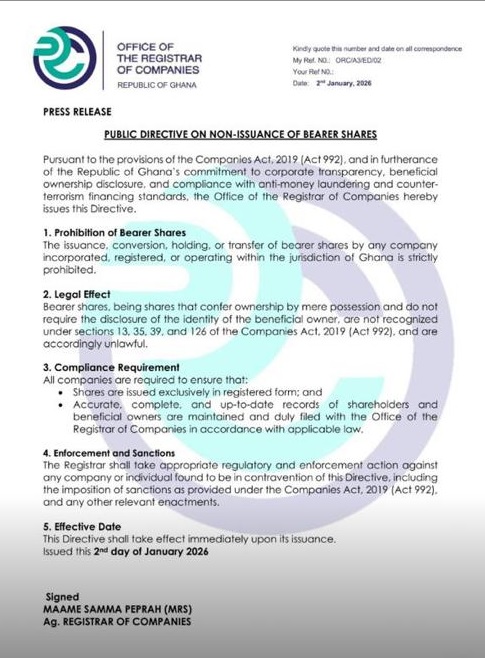
On January 2, 2026, the Office of the Registrar of Companies issued a Directive prohibiting the issuance, holding, conversion, or transfer of bearer shares in Ghana. Issued under the Companies Act, 2019 (Act 992), this directive underscores Ghana’s commitment to corporate transparency, beneficial ownership disclosure, and anti-money laundering and countering the financing of terrorism standards. It becomes effective immediately on the date of issuance, and companies are expected to comply promptly.
To understand this directive, it is essential to know what bearer shares are. Bearer shares confer ownership on the person who physically possesses the share certificate. Unlike registered shares, bearer shares do not record the identity of the shareholder or beneficial owner in the company’s register. Ownership is transferred simply by delivery, making such shares highly susceptible to abuse, secrecy, and illicit financial practices.
This directive clarifies that bearer shares are not recognized under the country’s company law. Under the Companies Act, 2019 (Act 992), ownership must be transparent and traceable, with full disclosure of beneficial owners and shareholders. Specifically, Sections 13, 35, 39, and 126 set out key requirements: Section 13 mandates that incorporation applications include detailed information on subscribers, directors, auditors, and beneficial owners; Section 35 requires companies to maintain a comprehensive register of members and beneficial owners; Section 39 establishes the register as the primary legal proof of ownership; and Section 126 obliges companies to submit annual returns detailing all members and beneficial owners. Bearer shares, which confer ownership anonymously based solely on possession of a certificate, cannot satisfy these statutory obligations, undermining transparency and accountability. Accordingly, bearer shares are unlawful, have no legal effect in Ghana, and are strictly prohibited from issuance, holding, conversion, or transfer.
All companies operating in Ghana are hence required to ensure strict compliance with the directive. In particular, shares must be issued exclusively in registered form, and accurate, complete, and up-to-date records of shareholders and beneficial owners must be maintained and duly filed with the Office of the Registrar of Companies in accordance with applicable law. This requirement aligns with Ghana’s beneficial ownership regime and ensures that regulators can readily identify the natural persons who ultimately own or control companies.
The Registrar of Companies has signaled a firm enforcement posture. Any company or individual found to be in contravention of the directive will be subject to regulatory and enforcement action. Sanctions may be imposed under the Companies Act, 2019, and any other relevant enactment, underscoring the seriousness with which the State views compliance.
The prohibition on bearer shares marks an important advancement in fortifying Ghana’s corporate governance system. Removing hidden ownership structures boosts transparency, safeguards the integrity of the corporate sector, and brings Ghana in line with international standards for fighting money laundering and terrorist financing. Directors, shareholders, company secretaries, and legal practitioners are advised to take note of this development and ensure full compliance with the Companies Act and the Registrar’s directive to avoid regulatory sanctions.